
Client
Client
Therhappi
Therhappi
Category
Category
Health - Tech Environment
Health - Tech Environment
Duration
Duration
6 Months
6 Months
Beta Soon
Beta Soon
Designing continuity in
mental healthcare
Designing continuity in
mental healthcare
22
22
Partnerships Pre-Launch
Partnerships Pre-Launch
$500K
$500K
Series - A Funding
Series - A Funding
Snapshot
Snapshot
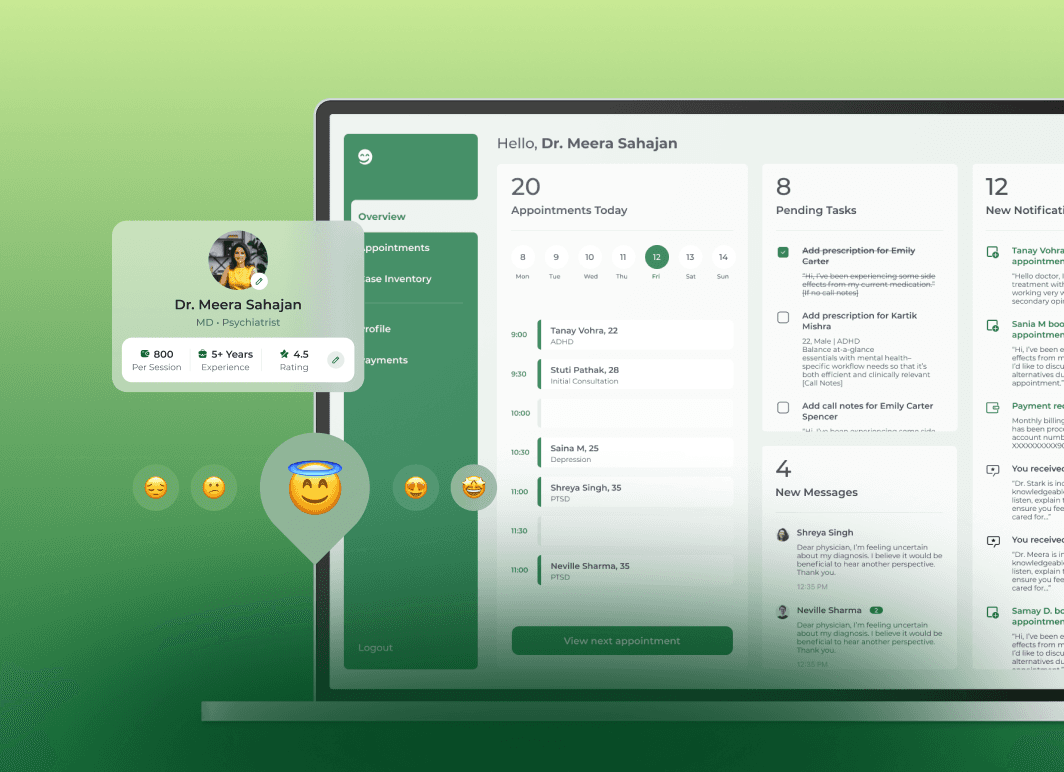
Therhappi aims to reimagine practice management for mental
health professionals and patients, by addressing the invisible gaps between care interactions with a connected ecosystem for patients, doctors, and organisations.
Therhappi aims to reimagine practice management for mental
health professionals and patients, by addressing the invisible gaps between care interactions with a connected ecosystem for patients, doctors, and organisations.
Facilitated a continuous care loop between doctors and patients
Facilitated a continuous care loop between doctors and patients
Reduced context switching for doctors during consultations
Reduced context switching for doctors during consultations
Improved patient engagement beyond sessions through tools
Improved patient engagement beyond sessions through tools
Problem
Problem
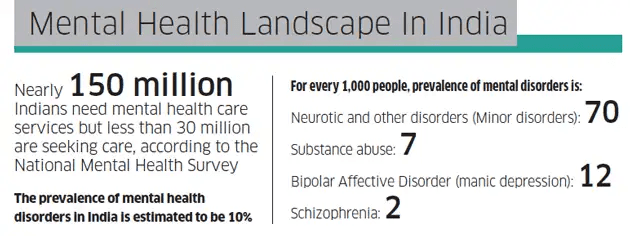
Mental healthcare breaks in the gaps between sessions, between tools and between doctor and patient. Doctors manage fragmented systems and patients disengage after consultations.
Mental healthcare breaks in the gaps between sessions, between tools and between doctor and patient.
Doctors manage fragmented systems and patients disengage after consultations.
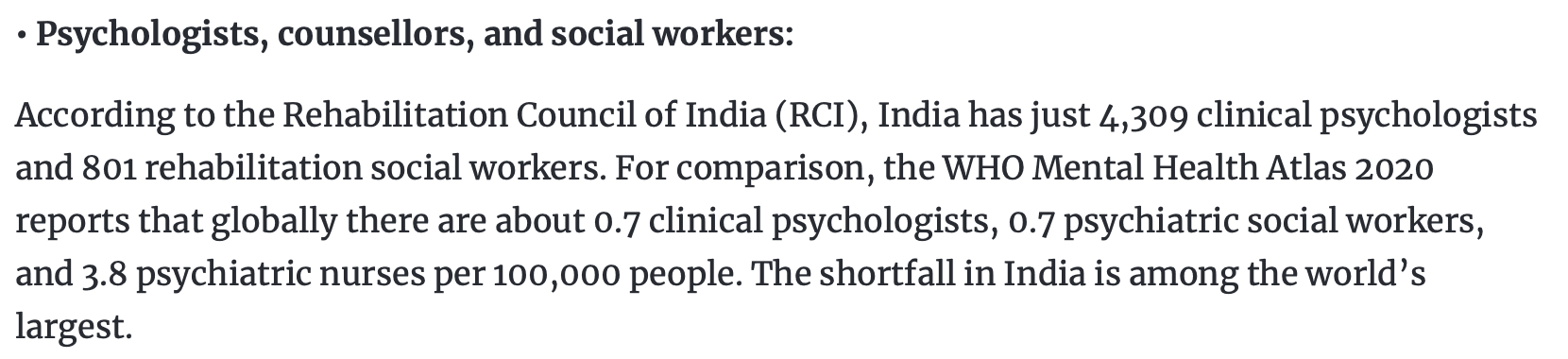
Existing products in market solve for appointment booking and doctor profilling.
There is a need to bridge what happens in between.
Existing products in market solve for appointment booking and doctor profilling. There is a need to bridge the middle flow.
How might we design a system that supports
continuous care, not just isolated consultations
How might we design a system that
supports continuous care, not just
isolated consultations




Approach
Approach
The client requirement was to book another app that enabled consultations
but thankfully, stakesholders were open to find a better market fit.
To understand where the system breaks, it was important that we focused on
both sides:
[A] Mental health professionals (psychologists, psychiatrists)
[B] Patients undergoing ongoing care
The research included semi-structured interviews with doctors, workflow
shadowing (pre, during, post consultation), patient journey mapping and
audit of existing tools & workflows.
The client requirement was to book another app that enabled consultations but thankfully, stakesholders were open to find a better market fit.
To understand where the system breaks, it was important that we focused on both sides:
[A] Mental health professionals (psychologists,
psychiatrists)
[B] Patients undergoing ongoing care
The research included semi-structures interviews with doctors, workflow shadowing (pre, during, post consultation), patient journey mapping and audits of existing tools and processes.
“I often recall things mid-session instead of seeing them.”
“I often recall things mid-session instead of seeing them.”
What I observed — Doctors
What I observed — Doctors
Context lives everywhere except where it’s needed
Context lives everywhere except where it’s needed
Consultations are followed by invisible admin work
(writing prescriptions & updating notes)
Consultations are followed by invisible admin work
(writing prescriptions & updating notes)
Appointments lack meaningful context like who the patient is,
what the doctors are dealing with
Appointments lack meaningful context like who the patient is,
what the doctors are dealing with
“The consultations are intense,
I feel clueless after it...
What do these conversations amount to?”
“The consultations are intense,
I feel clueless after it...
What do these conversations amount to?”
What I observed — Patients
What I observed — Patients
Care drops off after the session as patients forget prescriptions,
lose track of progress and disengage between sessions
Care drops off after the session as patients forget prescriptions,
lose track of progress and disengage between sessions
Medical data is all over the place: prescriptions, notes and advice
Medical data is all over the place: prescriptions, notes and advice
Therapy is not just conversations, it’s seeing changes manifest
in real life, the sooner the better
Therapy is not just conversations, it’s seeing changes manifest
in real life, the sooner the better
Phase 1
Phase 1
Experience Strategy
Experience Strategy
Insights from the research shaped the direction of the product, from managing appointments to enabling ongoing, connected care.
Insights from the research shaped the direction of the product, from managing appointments to enabling an ongoing, connected care.
A shared system where information flows
seamlessly across the two-sided system.
A shared system where information flows
seamlessly across the two-sided system.
Augmenting the doctor flow
Augmenting the doctor flow
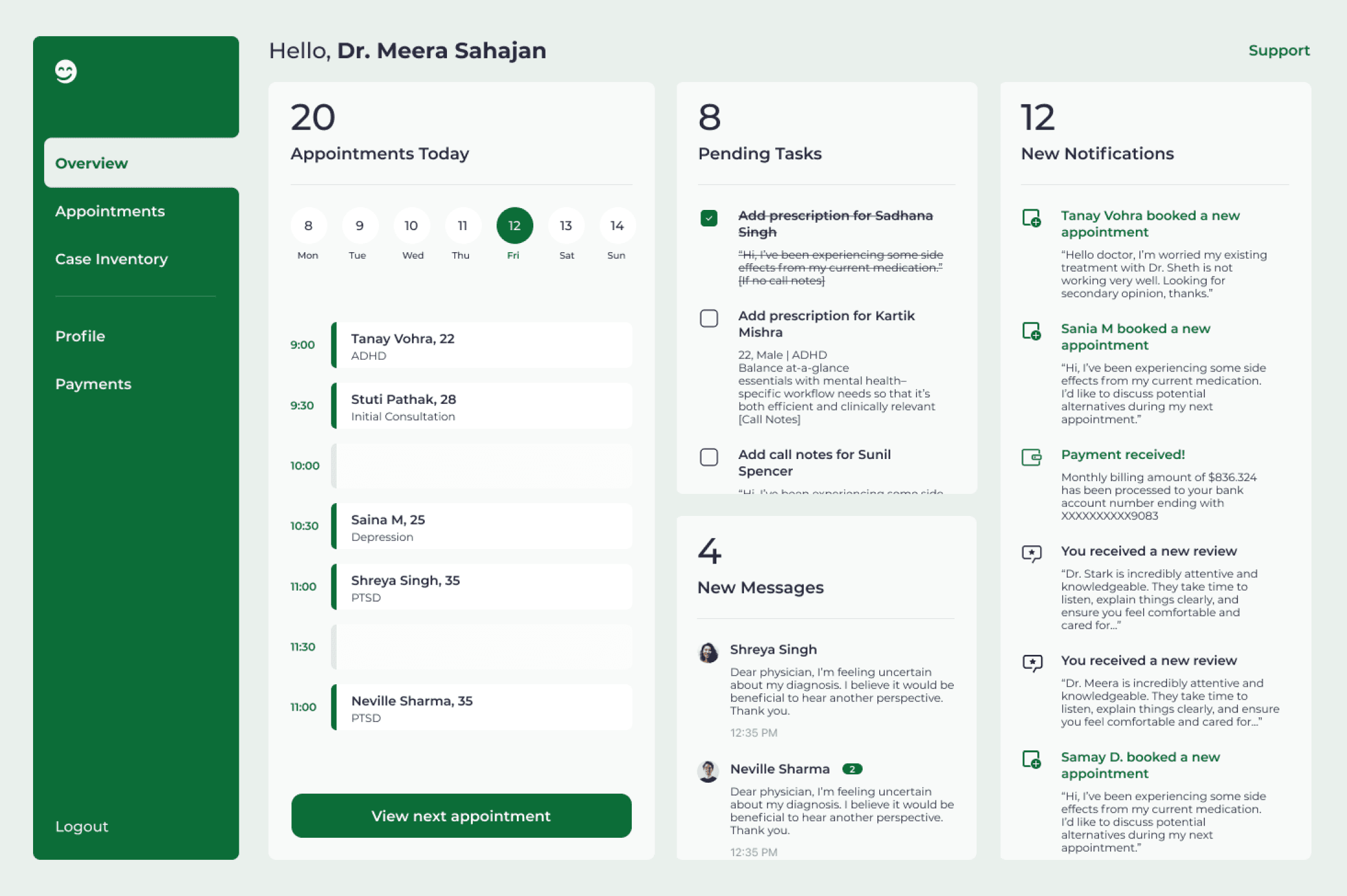
My initial hypothesis was increasing operational efficiency for doctors, will
improve the overall care experience, so I designed a dashboard with
appointments, tasks, messages, and calendar based scheduling.
Having every thing in place should give doctors enough time to prepare for
their consultations? I was wrong.
My initial hypothesis was increasing operational efficiency for doctors will improve the overall experience for patients too, so I set my directions towards a dashboard with appointments, tasks, messages and calendar based scheduling.
This might have fixed doctors' mismanagement of information but I was wrong in assessing that it would naturally fix the other part of the loop for patients too.
We needed more.
Usability testing with low fidelity screens clarified that there was no significant
change in both the journeys.
Usability testing with low fidelity screens clarified that there was no significant change in both the journeys.
All the prior patient history and prior consultation notes, prescriptions were still
divided across different platforms.
All the prior patient history and prior consultation notes, prescriptions were still divided across different platforms.
There was no context availability during critical moments for both doctors and
patients.
There was no context availability during critical moments for both doctors and patients.
Design for context
Design for context
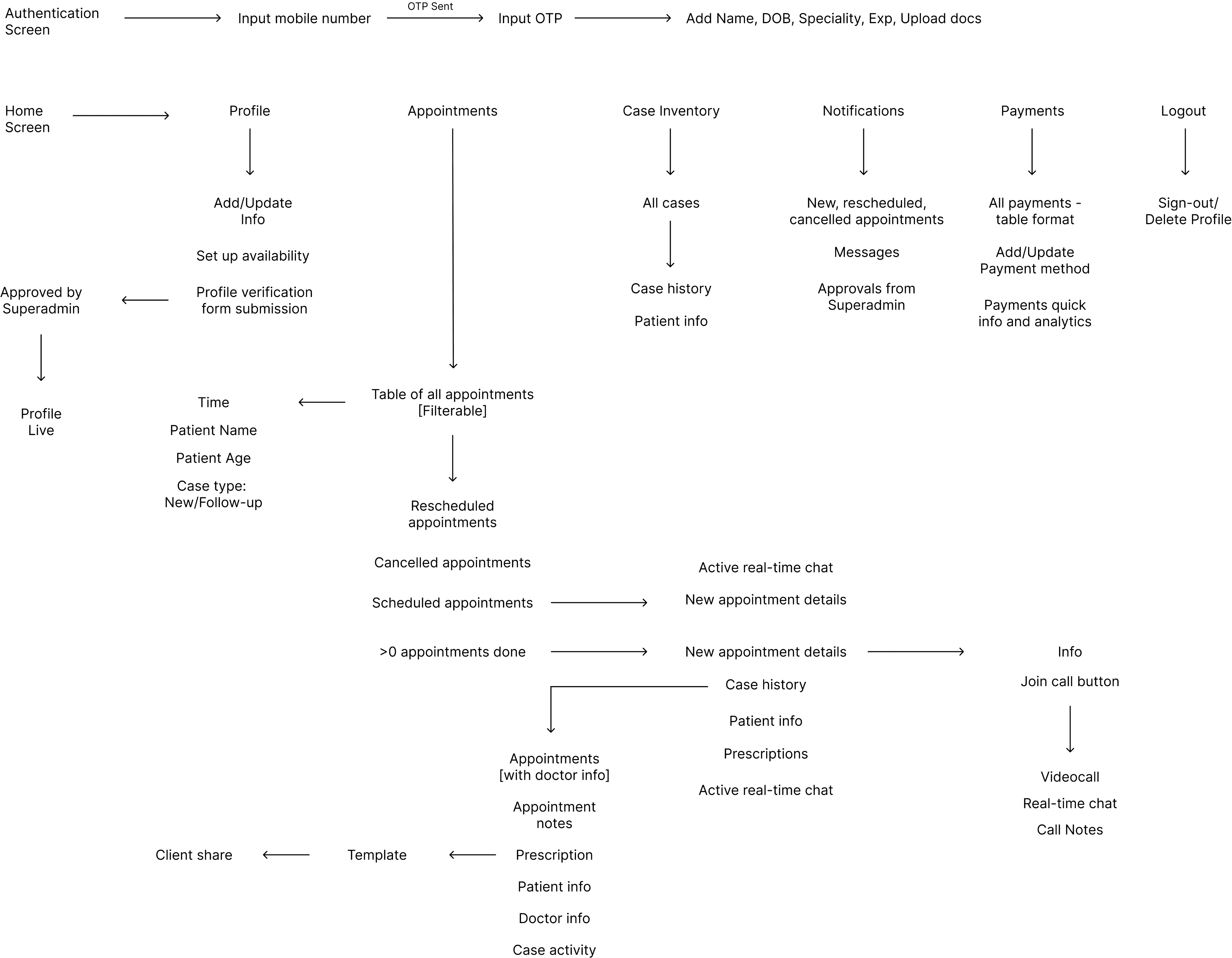
Introduction of a consultation with workspace interface: Instead of a
separate video + documentation flow: Video call + contextual side panel
and access to notes, prescriptions, messages within the call itself.
Introduction of a consultation with workspace interface: Instead of a separate video + documentation flow: Video call + contextual side panel and access to notes, prescriptions, messages within the call itself.
This definitely increased the UI complexity with an extended design system
but it eliminated post-consultation work. I had to choose complexity inside
the interface to reduce complexity outside the workflow.
This definitely increased the UI complexity with an extended design system but it eliminated post-consultation work. I had to choose complexity inside
the interface to reduce complexity outside the workflow.
Phase 2
Phase 2
Structuring patient context
Structuring patient context
Patient data existed, but it wasn’t structured for quick understanding during
the call consultations now that it had to co-exist. Doctors had to scan
through notes and reconstruct history manually.
Patient data existed, but it wasn't structured for quick
understanding during the call consultations now that it had to co-exist. Doctors had to scan through notes and reconstruct history manually.
Creating a source of truth
Creating a source of truth
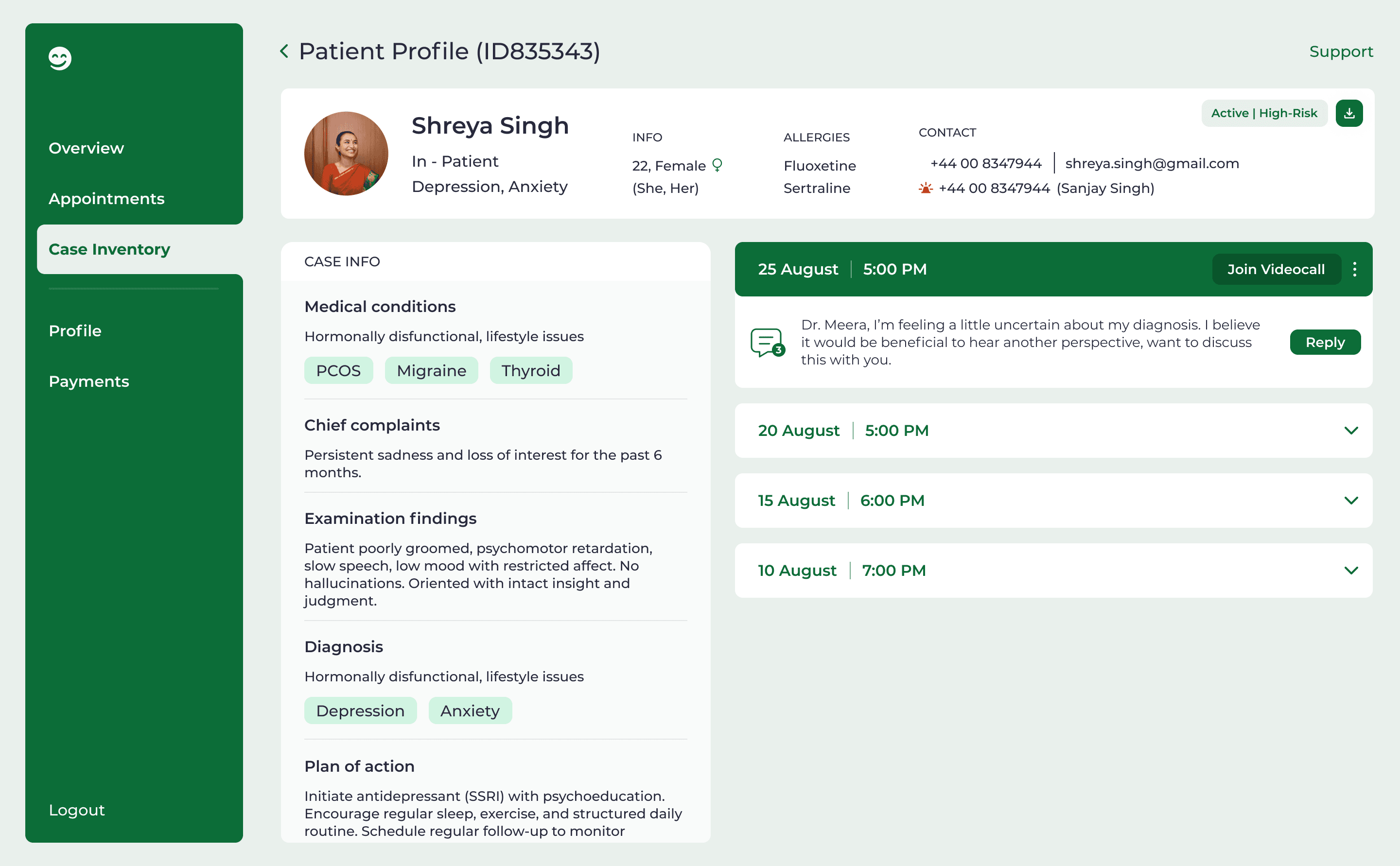
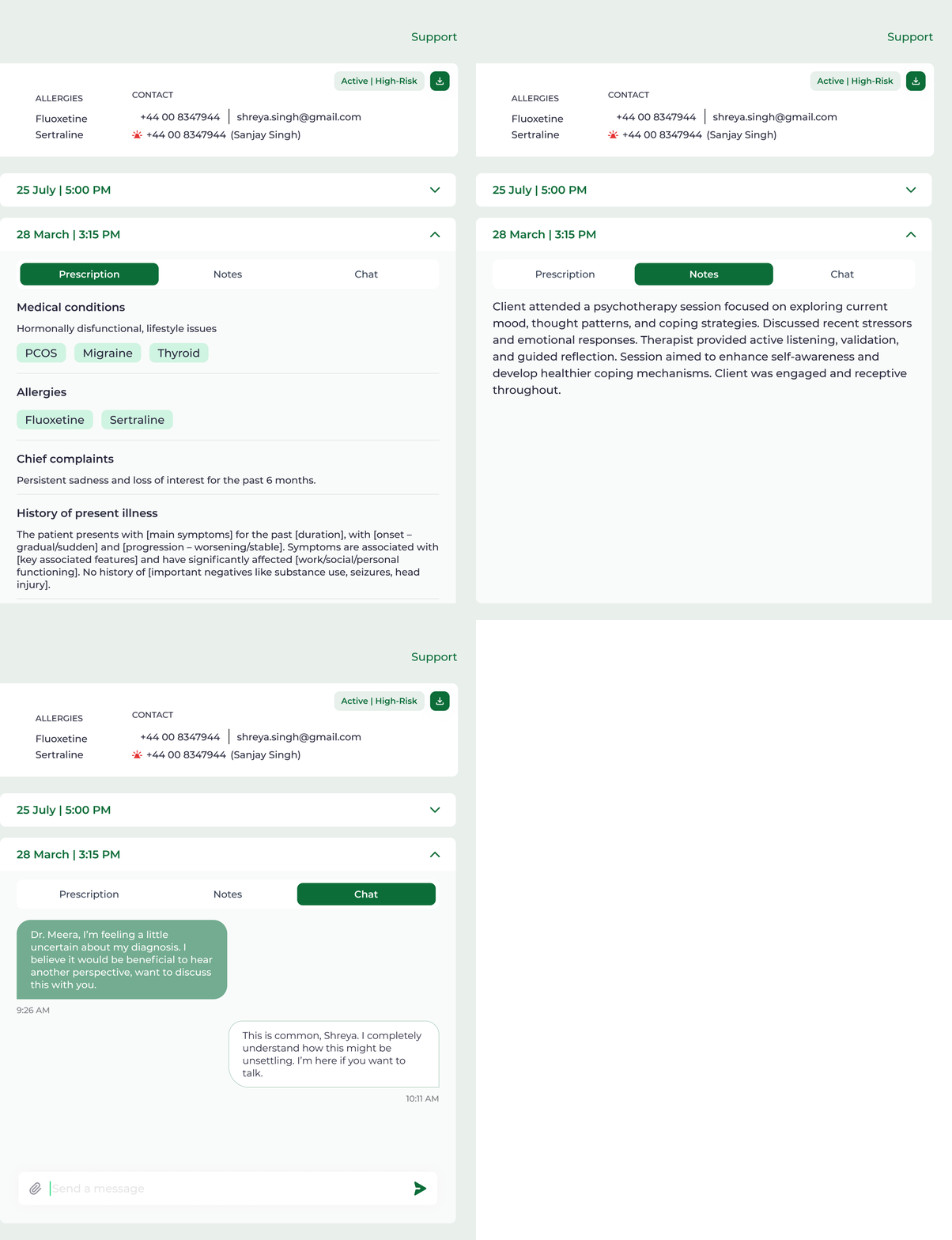
I created a patient profile CMS with all prior records like patient history,
medical history, family history of illnesses, prior diagnosis, medications and
more relevant data that will make a significant change in context of
consultations.
I created a patient profile CMS with all prior records like patient history, medical history, family history of illnesses, prior diagnosis, medications and more relevant data that will make a significant change in context of consultations.
The information density for this feature was solved using hierarchy and
progressive disclosure.
The information density for this feature was solved using hierarchy and progressive disclosure.
Phase 3
Phase 3
Fixing the Patient Experience
Fixing the Patient Experience
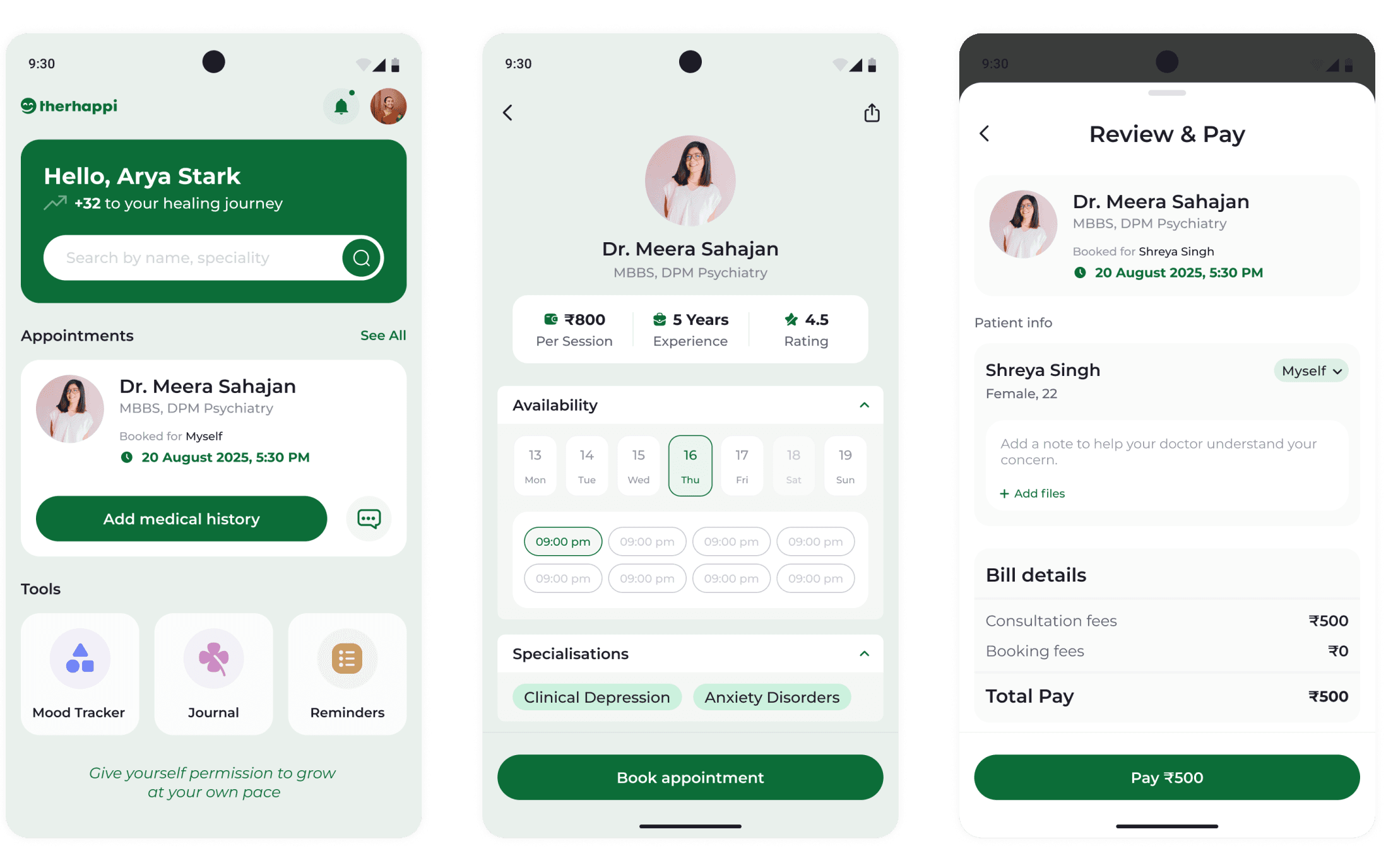
Initially, the patient app focused on doctor discovery, booking consultations
and joining calls. Patients dropped off after sessions, there was no
engagement, no follow-through and no continuity.
Initially, the patient app focused on doctor discovery, booking consultations and joining calls.
Patients dropped off after sessions, there was no
engagement, no follow-through and no continuity.
Adding a smart behavioural layer
Adding a smart behavioural layer
The patients needed to shift from passive recipients to active participants
in their own care and well-being. We also noticed that sooner the patients
saw a physical pattern in their real life, the sooner they started to believe in
their mental progress.
The patients needed to shift from passive recipients to active participants in their own care and well-being. We also noticed that sooner the patients saw a physical pattern in their real life, the sooner they started to believe in their mental progress.
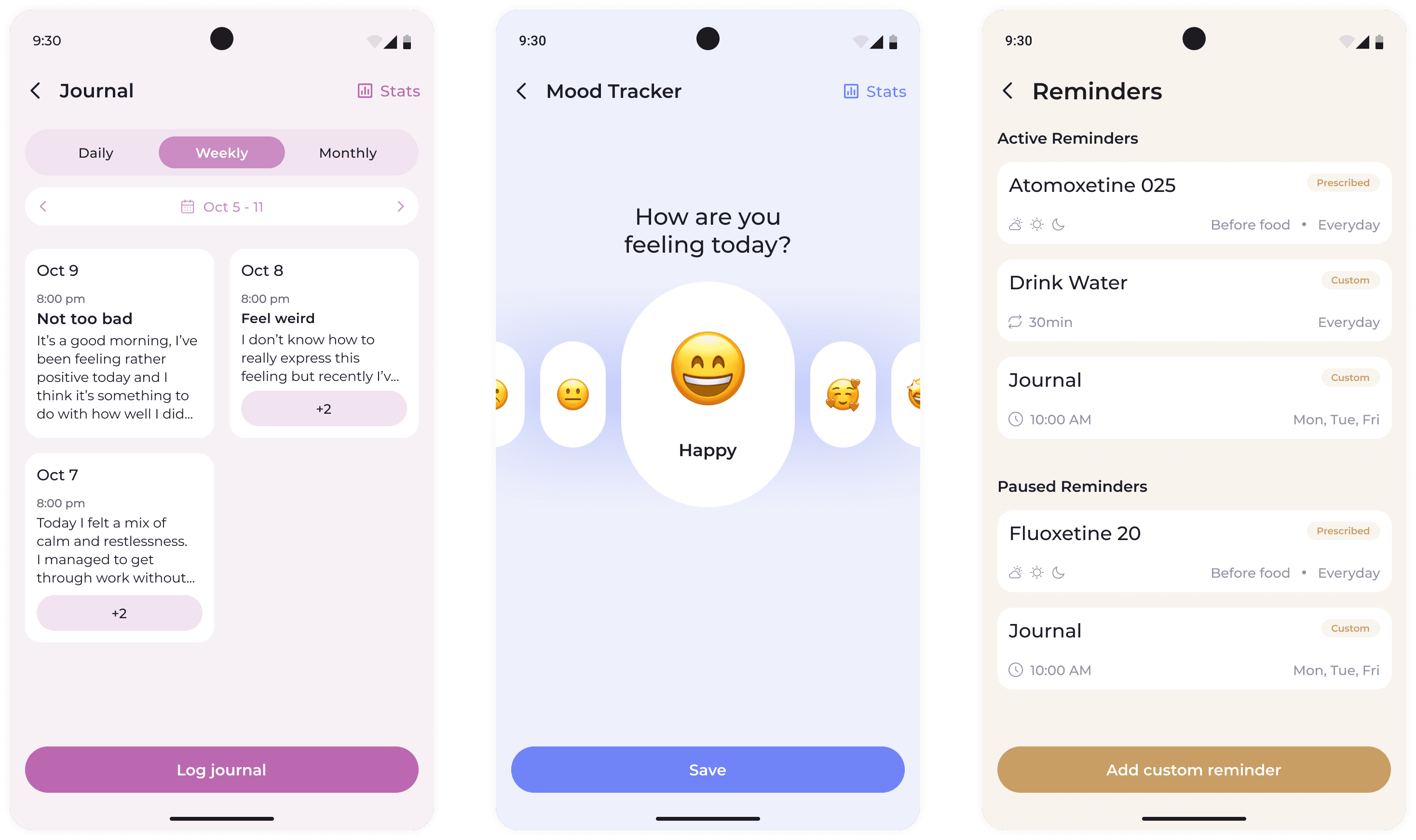
Adding more features risked overwhelming users, but had we to trade-off
focused user flow for real value. I added a tools section that was optional to
use but integrated into existing flows. This increased patient engagement
between sessions and improved treatment adherence.
Adding more features risked overwhelming users, but had we to trade-off focused user flow for real value. I added a tools section that was optional to use but integrated into existing flows.
This increased patient engagement
between sessions and improved treatment adherence.
Finale
Finale
Two way data flow
Two way data flow
Even with tools, the system was still one-directional: Doctors to patient, so it was important that we added [A] a messaging functionality for patients to reach out to their doctors which was accessible for 48 hrs before and after their appointment window.
Even with tools, the system was still one-directional: Doctors to patient, so it was important that we added [A] a messaging functionality for patients to reach out to their doctors which was accessible for 48 hrs before and after their appointment window.
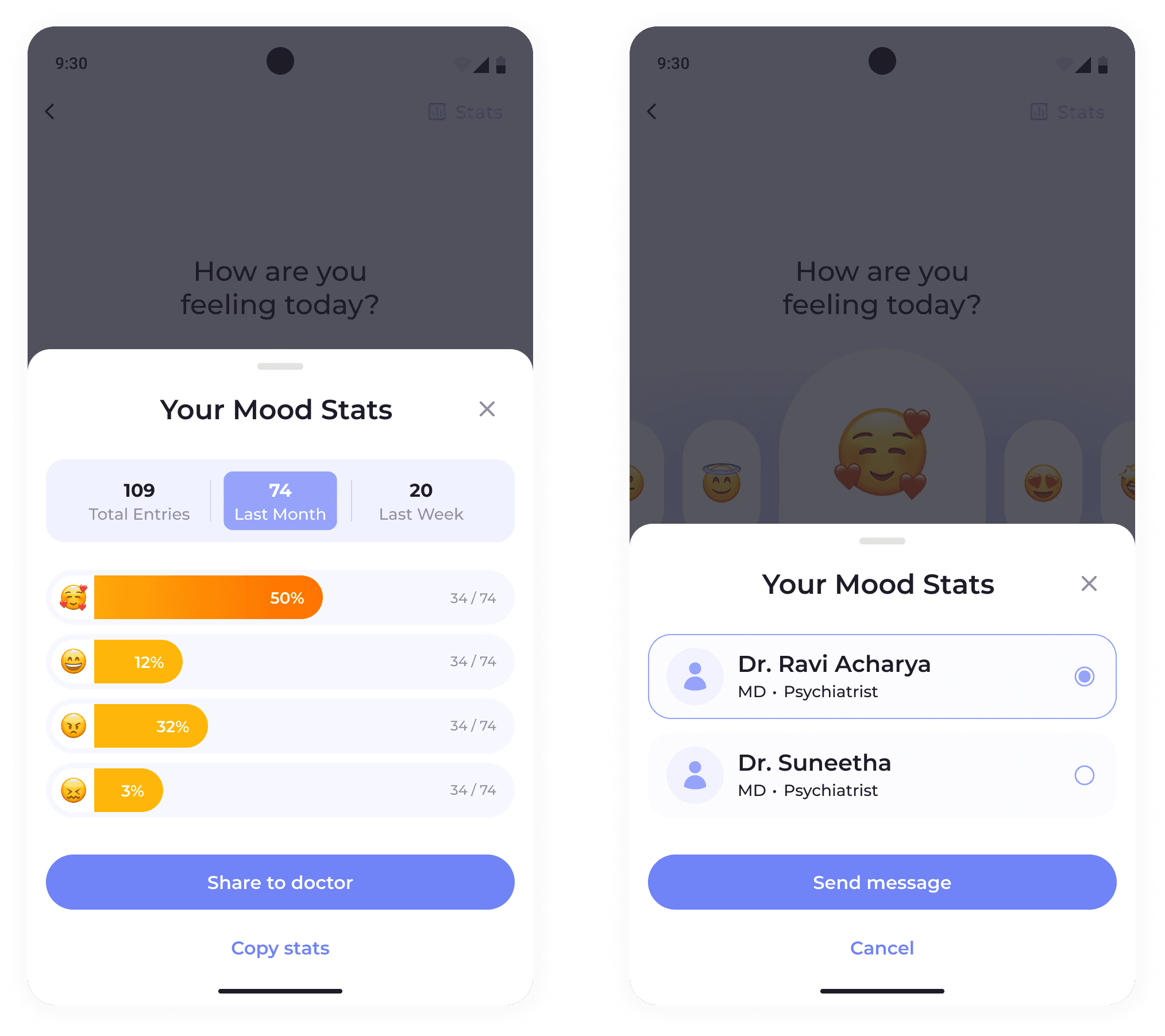
Another feature was also added that let patients share their otherwise encrypted journal, mood tracker data with doctors directly in chat.
Mood trackers and Journals enabled patients to be reflective of their progress, while Reminders helped them stay consistent.
Another feature was also added that let patients share their otherwise encrypted journal, mood tracker data with doctors directly in chat.
Mood trackers and Journals enabled patients to be reflective of their progress, while Reminders helped them stay consistent.
Mirrored mental models
Mirrored mental models
The doctors profiles were made in order to let the professionals see their
own information in patient view. They can edit their profile in a mobile-like
preview and changes reflect exactly how patients see them.
The doctors profiles were made in order to let the professionals see their own information in patient view. They can edit their profile in a mobile-like preview and changes reflect exactly how patients see them.
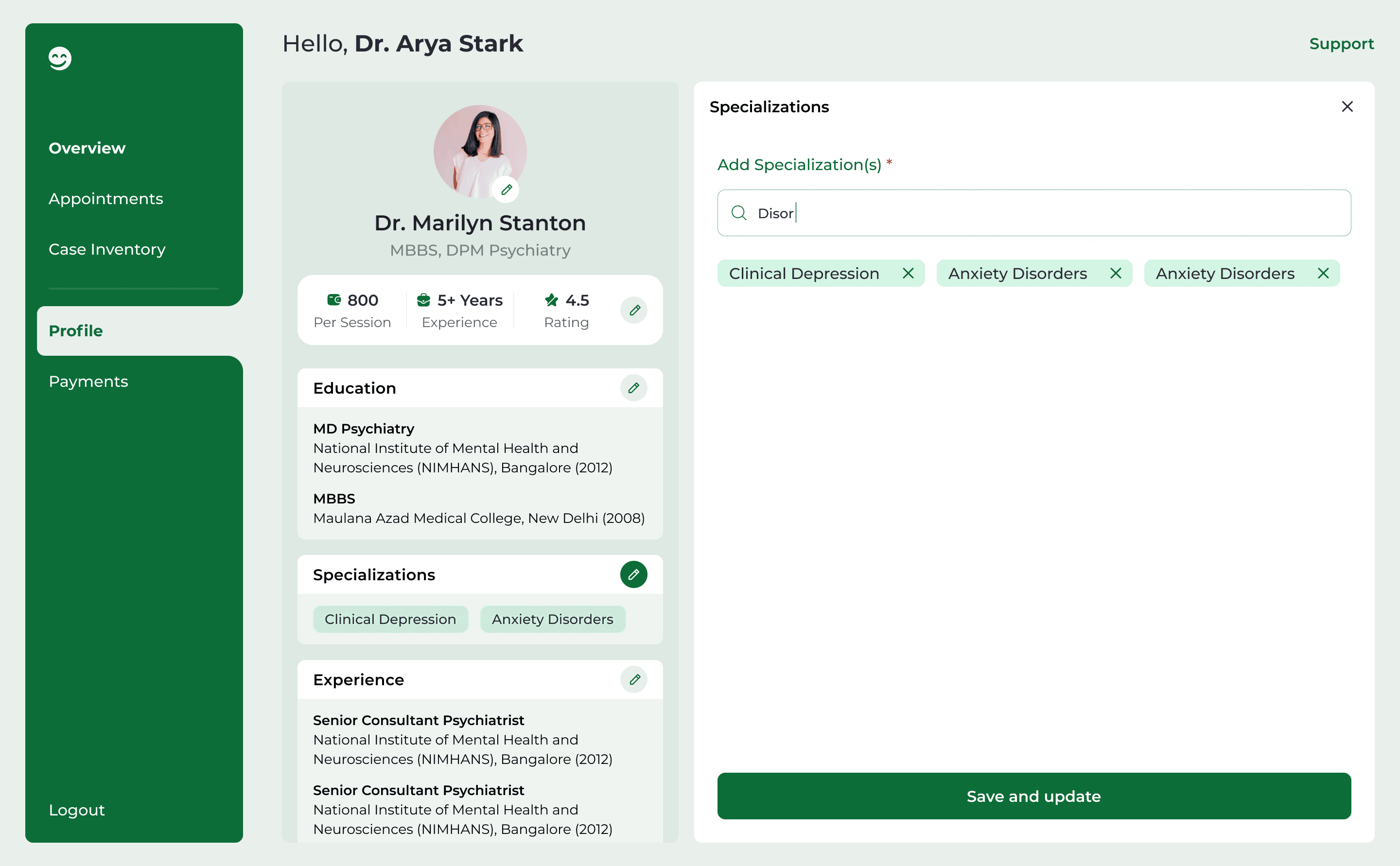
This not only reduced ambiguity but also improved trust and presentation,
and decision making on patient side.
This not only reduced ambiguity but also improved trust and presentation, and decision making on patient side.
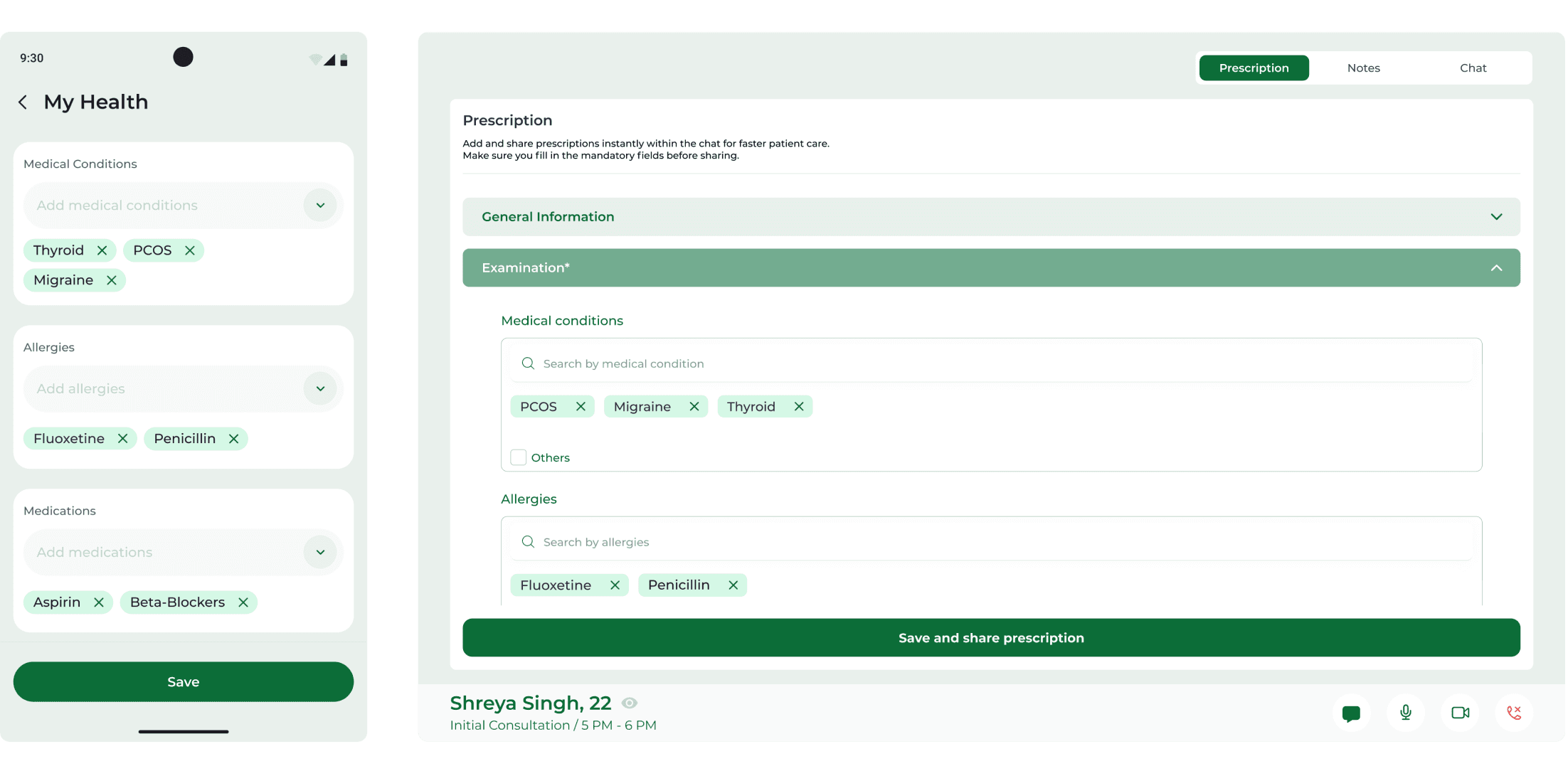
Pre-filled history in prescription
Pre-filled history in prescription
For medical records, and for sensitive use case like therapy, it’s important to
have context in all medical records. We made this seamless and faster by letting patients add their own medical history before the appointment so the doctor saw pre-filled inputs in the prescription during the call.
For medical records, and for sensitive use case like therapy, it’s important to have context in all medical records. We made this seamless and faster by letting patients add their own medical history before the appointment so the doctor saw pre-filled inputs in the prescription during the call.
What worked
What worked
The real product isn't the dashboard, the app, or the video call, it is the
continuity of information connecting all of them. Most tools are built for
doctors or patients, not for the relationship between them. We built a closed
loop where every interaction feeds the next, making care progressively
more informed.
The real product isn't the dashboard, the app, or the video call, it is the continuity of information connecting all of them. Most tools are built for doctors or patients, not for the relationship between them. We built a closed loop where every interaction feeds the next, making care progressively more informed.
Projected Impact
Projected Impact
99%
99%
Consultation completion rate
Consultation completion rate
87%
87%
In-Session Documentation
In-Session Documentation
1 mins
1 mins
Time to Patient Context
Time to Patient Context
18%
18%
Engagement with Tools
Engagement with Tools
What I Learned
What I Learned
Simplicity is contextual: something simple for patients can be limiting for
doctors. Good systems don’t simplify everything, they simplify differently for
each user.
Real value comes from loops, not flows? Flows end. Loops compound.
Therhappi became valuable when it enabled: continuous exchange, not
one-time interaction
Simplicity is contextual:something simple for patients can be limiting for doctors. Good systems don’t simplify
everything, they simplify differently for each user.
Real value comes from loops, not flows? Flows end. Loops compound. Therhappi became valuable when it
enabled: continuous exchange, not one-time interaction.
Go back to all
Go back to all



More projects
More projects
Check out some of my favorite & most recent projects.
Check out some of my favorite & most recent projects.